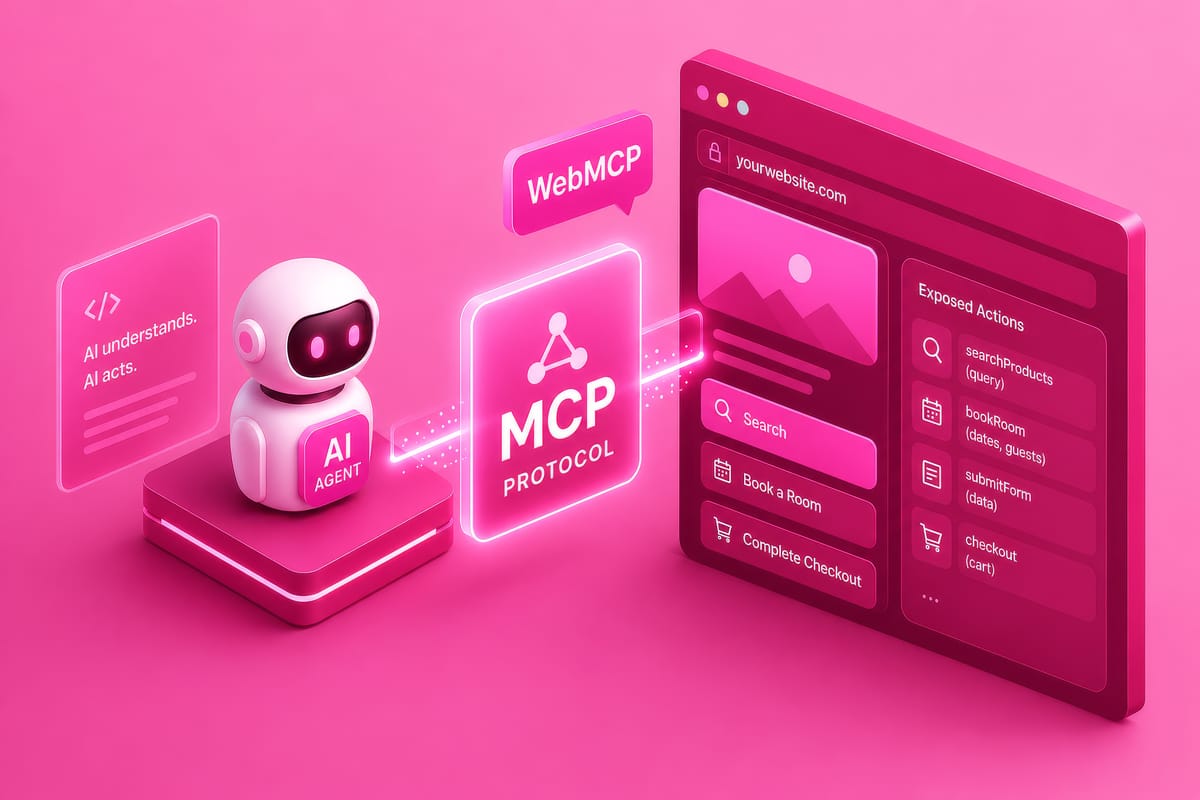

AI agents are starting to browse, book, search and interact online. WebMCP is helping them do it properly
Not so long ago the idea of AI directly interacting with websites sounded futuristic. Today, it’s becoming infrastructure.
MCP, short for Model Context Protocol, changed the way developers think about AI integrations because it gave models a proper way to communicate with websites, operate tools, manipulate and read databases and use apps. Instead of duct taping random APIs together and hoping things do not fall apart at Saturday 2AM, MCP introduced structure. AI could finally understand what tools exist, what actions are available and how to use them without improvising every single step.
Now WebMCP is taking that same concept directly into the browser and honestly, this is where things start getting interesting.
Today most AI agents use websites exactly like humans. They scan buttons, inspect HTML, click elements and pray the frontend developer did not rename a CSS class into something awkward. It works surprisingly well until suddenly it does not. One redesign later and the whole workflow collapses like a folding chair.
Instead of forcing AI to visually interpret websites, platforms can expose structured actions directly to agents in a machine understandable way. Search products. Submit forms. Create bookings. Start checkouts. Fetch availability. Clean communication between platform and agent. No guessing and no chaos. Just direct interaction.
Your website basically becomes understandable to AI in a native way and that matters way more than people think. Imagine asking your AI assistant to book a 5-star hotel for four nights with spa access, garage parking and late checkout under €2500. Instead of opening twenty tabs and rage scrolling booking forms, the AI agent directly interacts with hotel systems through structured actions exposed via WebMCP. It checks availability, compares room types, filters packages, confirms parking, and even completes the booking flow. All done in minutes without the usual digital suffering we all pretend is normal.
The internet is quietly moving from human only experiences toward human + AI agent experiences. Ecommerce stores, booking systems, SaaS dashboards, CRMs, support portals, healthcare systems and hospitality platforms will all be affected sooner than most companies expect. The brands preparing for this shift early will feel effortless to use. The others will suddenly feel ancient. And honestly, a lot of websites today are not even remotely ready for this.
Most platforms still operate like AI agents do not exist. Forms are messy, actions are unclear, interfaces depend on fragile frontend tricks and business logic is buried somewhere deep inside JavaScript chaos. Humans can still navigate that mess because we improvise. AI agents, on the other hand, tend to get lost when the rules are unclear. That leads to broken flows, failed checkouts, incomplete bookings and weird automation behaviour that makes everyone blame “AI” when the real issue is the website architecture itself.
The next generation of digital experiences will not just be mobile friendly or fast loading. They will be machine understandable, structured and action driven. Ready for both humans and AI agents at the same time. And the businesses that figure this out early will have a serious advantage and less friction. So basically less “why is this thing broken again?” energy floating around.
The cool part is that WebMCP is not trying to replace websites. It is trying to make them interoperable with AI systems in a cleaner and more reliable way. Think less screen scraping and image reading and more structured workflows; less browser gymnastics and more direct communication between systems.
Big players are already moving in this direction. Browser vendors, AI companies and enterprise platforms are actively exploring how agent ready web experiences should work. Which honestly makes sense because AI agents are useless if they constantly get stuck clicking the wrong button on somebody’s outdated or perplexing frontend.
One day companies will realize their competitors have AI agents booking faster, supporting users faster, processing workflows faster and integrating systems faster and at that moment everybody will scramble to catch up.
Honestly, that would be the most classic internet moment ever.
At PMN Digital we help businesses prepare for this next generation of AI integrated experiences through architecture consulting, frontend and backend implementation, structured workflows, AI integrations and agent ready systems. If you want your platform to work with the next wave of AI instead of fighting against it, let’s talk.