
Last click is lying to you
How to see which marketing actually brings sales, not just clicks.
In short: Ad platforms each take credit for the same sale, and last-click reporting rewards whichever channel happened to be last. To see what really brings revenue, tie every enquiry, form and call to its source on your own first-party data, follow it through the CRM to a qualified lead and a closed sale, compare attribution models side by side, and send the real outcomes back to Google Ads and Meta so their algorithms learn from sales instead of form fills.

Here is a scene we see more often than we would like. At the end of the month, Google Ads reports twelve conversions. Meta reports nine. The sales team really closed eight deals, and nobody in the room can say which campaign brought which customer. Everyone is a little bit right and the budget meeting turns into a debate about whose dashboard and numbers to believe. If that sounds familiar, the problem is not your team. Every ad platform grades its own homework: Google counts the sales that followed a Google ad, Meta counts the ones that followed a Meta ad (by default even people who only saw one the day before), and both happily claim the same buyers. And even once every sale is counted only once, most marketing is still judged by the last click, which tells only a small part of the story.
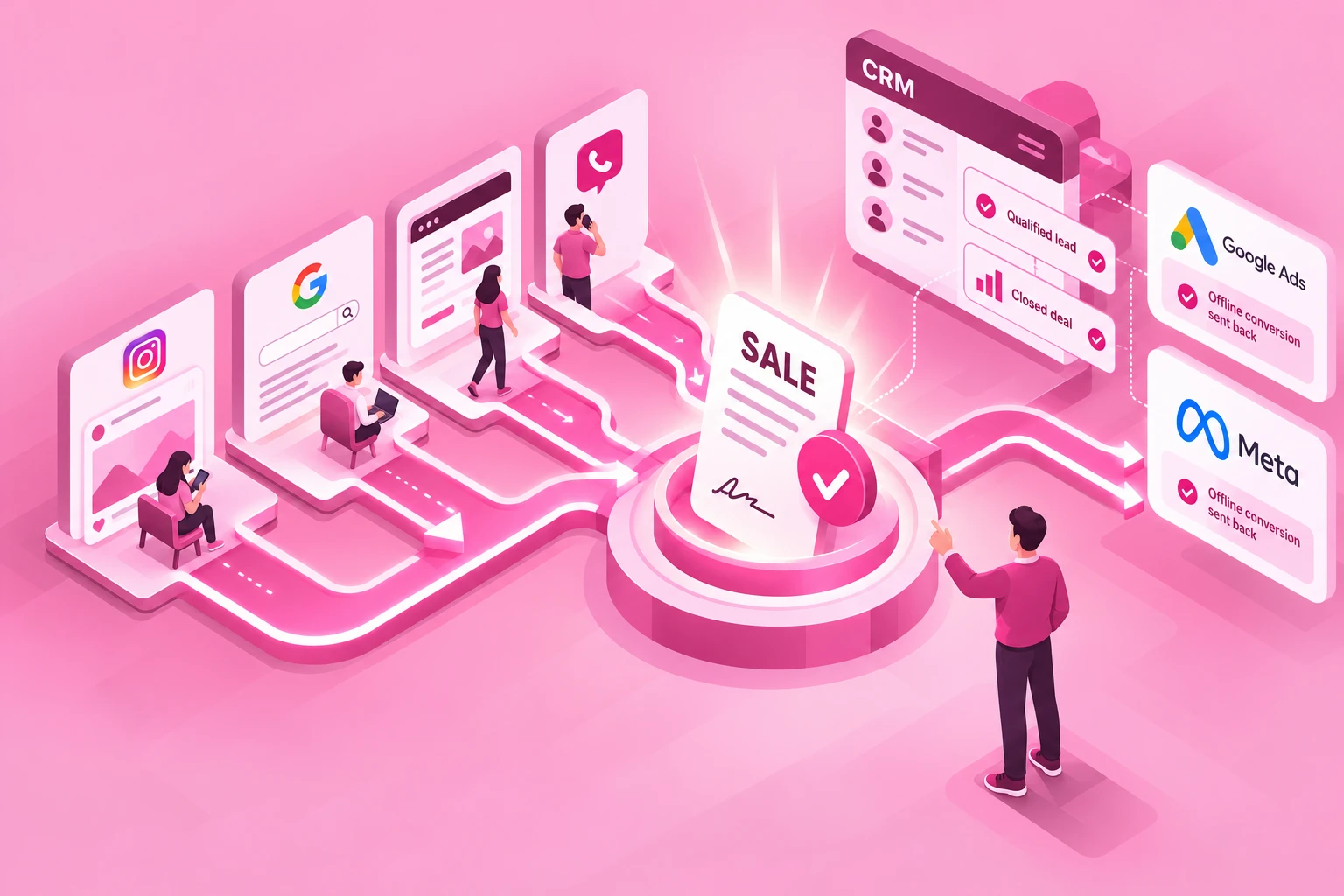
Think about how people actually buy anything that matters. Someone sees your ad on Instagram while scrolling on the tram. A few days later they search for you on Google, read two pages and leave. A week after that they come back by typing your address, call your office, talk to a salesperson and sign three weeks later. Which channel made that sale? Last-click reporting gives the full credit to the final visit, the one where they typed your name, and quietly ignores the ad that introduced you in the first place. Meanwhile Instagram and Google each see their own piece of the journey and each counts the sale as theirs. That is how twenty-one reported conversions turn into eight signed deals.
Different ways to share the credit
Attribution is simply the question of who gets credit for a result, and there is more than one fair answer. First touch gives everything to the channel that started the relationship, which is great for judging awareness campaigns. Last non-direct click gives it to the last real marketing touch before the sale, skipping visits where people just typed your address. Linear splits the credit evenly across every touch. Position-based gives the biggest shares to the first and the last touch and spreads the rest in between, and time-decay gives more weight to whatever happened closer to the sale. None of these is the one true answer. The value comes from putting them side by side: when a channel looks weak on last click but strong on first touch, it is probably doing the hard work of finding new customers, and cutting it would hurt you a month later, not today.
It is worth knowing that the ad platforms themselves have narrowed these choices. In 2023 Google retired first click, linear, time decay and position-based models in Google Ads and Google Analytics, leaving data-driven attribution and last click. Data-driven models can be clever, but they live inside one platform and see only what that platform sees. If you want to compare channels honestly, the comparison has to happen on data that belongs to you, not to the companies selling you the ads.
Your own data is the foundation
That is where first-party data comes in. Instead of relying on third-party cookies that browsers delete and ad blockers stop, you measure visits and enquiries on your own domain, in a way that respects the visitor's consent choice. We wrote about the technical side of this in the beauty of server-side tracking, and about getting consent right in common mistakes in GDPR cookie consent modals. Done properly, privacy and good measurement are not enemies. A visitor who declines tracking is respected, and a visitor who agrees gives you a clean, durable record of where they came from.
The next step is the one most setups skip: following the lead after the form. A form submission is not a sale. Neither is a phone call. What matters is what happens in your CRM afterwards: was the enquiry a real prospect, did it become a qualified lead, did it end in a signed deal, and how much was that deal worth? When every enquiry, form and call carries its source with it into the CRM, you can finally answer the question the budget meeting was really asking, which campaigns bring revenue. Calls deserve special attention here, because in many industries the best customers pick up the phone, and a phone call usually vanishes from analytics the moment it starts. Just as important is weeding out the noise. Spam, duplicates and enquiries that were never a fit should be labelled and kept out of the reports, otherwise the campaign that attracts the most junk looks like your best performer.
Teach the algorithms what a sale looks like
Here comes the part that turns measurement into better results. Google Ads and Meta are very good at finding more of whatever you tell them is a conversion. If you tell them a form fill is a conversion, they will find you more form fills, including the ones that never answer the phone. If you send back what really happened, that this lead was qualified and that one closed for a certain value, the algorithms start looking for people who resemble your actual customers. This is what offline conversions are: your real outcomes, sent from your own data back to the platforms, matched to the click that started the journey. It is one of the most effective improvements you can make to paid advertising, and it costs nothing in extra ad spend.
So how do you know where you stand? Try a simple test. Pick your last ten closed deals and ask whether you can name the campaign, or at least the channel, behind each one. Ask whether your reports separate a good lead from a spam form, whether phone calls are counted at all, and whether Google and Meta are learning from sales or from clicks. If most of the answers are "not really", you are not alone, and you are probably spending part of your budget on the channel that probably contributes but also shouts loudest rather than the one that sells.
Connecting marketing to revenue is not a single tool you switch on. It is a chain: consent-aware tracking on your own domain, sources carried into the CRM, honest comparison of attribution models and real outcomes sent back to the ad platforms. Each link is manageable on its own, and together they turn the monthly debate into a much clearer picture of what is working. If you would like to see where your chain breaks, take a look at our analytics and tracking services or tell us how your sales happen today, and we will help you trace the path from the first ad and whole channel to the closed deal.